Might offend someone 🤞🏻

We live in a world where things are often presented and perceived in black and white. If you have read my previous essays, many of you have probably come to the same conclusion as I have. Things can be simplified, and those simplifications can also be believed as absolute truths.
One evening, I asked myself what I would remove from this world to make it a better place. The obvious answers came to mind first: evil, hatred, injustice, wrongdoing, death, and so on. Then another thought occurred to me: how do we actually define these things?
Would removing death from the world mean that no one would ever die again, or that people would no longer be killed, or that no one could die from illness? If I removed evil from the world, what would happen then? Does evil include everything from killing and racism to injustice, colonialism, or even deception?
If evil did not exist, then naturally its opposite — goodness — would not exist either. That is a separate discussion in itself, but achieving balance always requires the existence of both extremes. In the end, I came to the conclusion that I could not remove anything from this world without fundamentally altering the very foundations of existence.
“One image accompanied by a short, attention-grabbing clickbait headline is enough to convince us that we know the truth.”
I have noticed that we humans need absolute answers — things we can trust and hold on to. That is why even complex issues are forcibly reduced to their simplest possible form.
No one in this world can provide answers with one hundred per cent certainty. And perhaps we do not really crave the truth at all — we crave certainty.
People would rather cling to a simple explanation than face a complicated reality, because certainty often feels safer than knowledge. To borrow an old Finnish saying: knowledge increases pain — and, on top of the pain, apparently requires extensive research as well.
These days, many people are unwilling to invest the time and effort required to search for information when social media provides everything ready-made and condensed into a carousel of a few sentences.
That is why, for many people, one photograph of a burkini is enough to “prove” that a Muslim woman cannot choose, while one photograph of a Hollywood actress is enough to “prove” that in the West, choice is always free. One image accompanied by a short, attention-grabbing clickbait headline is enough to convince us that we know the truth.
A good example of this was Anne Hathaway’s full-coverage swimsuit. At this point, you may be wondering: “What does this have to do with anything?”
Don’t worry — this is not an essay about different kinds of swimwear. It is about who ultimately gets to decide how we should dress. You can see Anne Hathaway’s swimsuit in this Vogue article.
Women’s magazines made the most of Anne’s beachwear, describing it in their headlines as inspiring. In the comments on social media, however, a clear contradiction emerged. Muslims understandably saw this as a double standard, because the way Muslim women dress often seems to make the West’s top ten list of favourite discussion topics.
Some Western commenters treated it as an absolute truth that Anne’s swimsuit was acceptable because no one was forcing her to dress that way — she had been allowed to choose.
This raised a few questions for me, because I find this idea highly generalising and stereotypical — and precisely for that reason, deeply problematic.
First, the comment divides the world into two sides: us versus them. It also suggests that Western women always get to choose, while other women do not.
Despite numerous Muslim women in the comments explaining that they themselves choose to dress in a certain way, their voices were repeatedly dismissed. And with that, the circle closed around the very heart of the “white saviour” phenomenon.
One commenter asked the person who had made the original comment: “If women are being oppressed, why are women the ones who have to suffer the consequences of that oppression?”
It was an excellent question because it forced the commenter to consider why women should be punished for a problem caused by an external factor.
However, the question does not tell the whole story. Its point was to ask: if someone wants to cover their body, why should they be punished because some women experience oppression caused by men, culture, or societal expectations?
Whether someone chooses to cover themselves or not is not what matters in this discussion. What matters is who gets to decide — and whose decision is considered oppression.
Westerners tend to believe that they are free to dress as they wish, yet even among us, people are deprived of autonomy when it comes to clothing.
In 2021, Norway’s women’s beach handball team decided to wear shorts instead of the bikini bottoms required by the rules, and the team was fined for doing so. The men’s team was allowed to wear shorts, while women were required to wear bikini bottoms.
The dress code was based on the rules of the International Handball Federation (IHF). At the time, the federation was headed by Egyptian Hassan Moustafa, under whose leadership the rule had been in place for years. Following the controversy, however, the IHF changed its rules and allowed women to wear shorts as well.
The bikini-bottom debacle nevertheless raised an interesting question: why were the men not required to wear tight, high-cut swim briefs with sides no wider than ten centimetres?
At the Tokyo Olympics, a German gymnast replaced the traditional high-cut leotard with a full-body unitard. The purpose of the change was to challenge the sexualisation of women in sport.
Beginning in 2007, FIFA prohibited women from wearing headscarves, including the hijab. The hijab ban in FIFA competitions was effectively lifted in 2012 when approved protective head coverings were permitted, although the change was not made permanent until 2014.
In France, meanwhile, numerous municipalities and cities have attempted to ban full-coverage swimwear altogether, without lasting success.
Is it acceptable to make the sweeping statement that Muslim women are oppressed? And is it acceptable to say that restrictions on women’s clothing in Western countries are justified?
The answer to both is no.
Oppression is created by people, cultures and the exercise of power — not by religion itself. It is of course true that different interpretations contain different views, but ultimately, the one enforcing them is always someone, not something.
Oppression and subjugation are not acceptable in any culture or context, and they should always be challenged. But taking away someone’s freedom of choice is not the solution. In fact, it is precisely the same thing Western commenters claim to oppose: taking away the option to choose.
In other words: oppression.
Freedom of choice is therefore not a universal condition. It is a social privilege that varies according to circumstances, environment and the exercise of power.
This is why full-coverage swimsuits worn by Anne Hathaway or favoured by many South Koreans are easily regarded as acceptable, while people propose banning the burkini.
And this is exactly where the enormous, elephant-sized double standard becomes visible.
Expectations surrounding clothing are not limited to international sport. Finnish everyday life also has unwritten rules about what is considered acceptable.
In Finland, nudity in the sauna is considered natural. If you want to keep your swimsuit on, you may find yourself having to explain your choice, or you may even be considered impolite. At the beach, the expectation is often the opposite: you are expected to wear a bikini or swimsuit.
In both situations, the surrounding environment tells us what is “normal”.
Finnish saunas provide a good example of how norms change depending on context. In separate women’s and men’s saunas, nudity is often assumed, and wearing a swimsuit may be restricted or regarded as unusual. In many mixed-gender saunas, however, the situation is reversed: swimwear is expected or even mandatory.
The issue, then, is not whether nudity or covering oneself is right or wrong. It is about how our surroundings determine what is considered acceptable in any given situation.
Revealing clothing should never be used to justify harassment, and covering one’s body should never be used to justify condemnation.
And yet, dressing modestly is often frowned upon, because apparently other people should be able to determine with absolute precision what you are allowed to wear and how much of yourself you should show to the world in order to be considered “acceptable”.
“The truth is that the oppression of women will exist for as long as someone else is allowed to decide what we should wear.”
Freedom does not mean everyone making the same choice.
True freedom means that both choices are equally possible and equally valid.
And the uncomfortable truth is that the oppression of women will exist for as long as someone else is allowed to decide for us what to wear — and how to wear it.
I dress the way I want to.
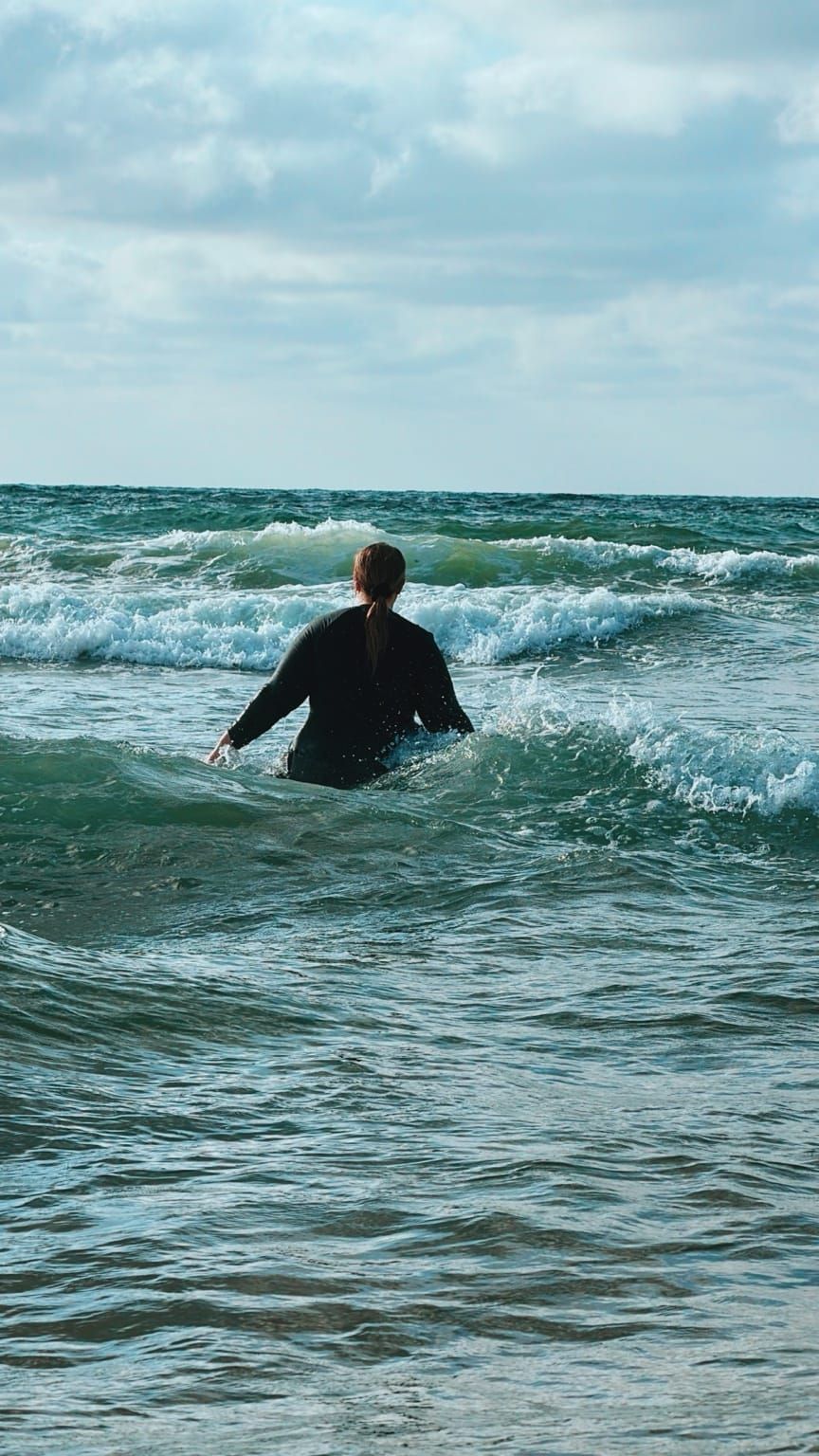
I would also like to inform you that I am a proud burkini wearer. And I will answer the most common question in advance: yes, I chose to wear this to the beach myself. And no, my husband had absolutely no influence over either my decision to buy it or my decision to wear it.
No one’s body should be a societal project.
And no individual’s freedom should be negotiable — not by culture, not by religion, not by society, and not by anyone else.
Ever.
-Sanni M.