The Finnishness a DNA Test Cannot Tell You
I once had a conversation about MyHeritage DNA tests. The conversation very quickly turned to how boring it would be to take one and discover that you were 100% Finnish. The exact same thing happened to me years ago, when I took the test myself. The result was, without a doubt, 100% Finnish.
Years later, I went back to look at my results again. Following one of MyHeritage’s segment updates, 1.1% Baltic ancestry had appeared in my results. Only now did I start looking at the results more closely, and I realized something important.
Not only am I Finnish, but my ancestry is very strongly Finnic. My genetic ancestry is heavily concentrated in the regions of Northern Savonia, Eastern Finland, the Republic of Karelia, the Leningrad region and Vyborg. The result is remarkably concentrated, and together with my genealogical research, it gives me a strong sense that my ancestors remained in roughly the same geographical area for a very long time.
I grew up in Northern Savonia, and both sides of my family have a strong Savonian and Eastern Finnish cultural background. Soups and other traditional dishes, coffee brewed in a pot, and a strong tradition of handicrafts among the women in my family have all survived to this day.
My father’s family has been extensively researched, and my oldest known ancestor lived in Northern Savonia as early as the 1500s. Yet only a few generations ago, life was still very concretely tied to the same region.
Both of my father’s parents were very much from Northern Savonia: my grandmother was from Nilsiä and my grandfather from Säyneinen. My grandmother’s family had a farm, which is still in the family’s hands. When my grandmother and her siblings were children, their grandmother also lived in the same house with them. Later, when my father’s uncle went into the army, my father’s family moved to the farm to help look after the cattle. My father attended the local school there for his first year and spent some time living on the farm with his cousins.
The family connection has also been consciously maintained. My father’s grandparents were among the people who originally founded our family association. Looking back, it feels almost like a continuation of something that has always existed in my family: the desire to keep people connected, to preserve traditions and to know where we came from.
That same connection was still present in my own childhood. My father’s cousins, who had grown up with him and shared at least part of his childhood, later became part of my sisters’ and my own lives as well. They looked after us when we were children.
In my family, community has never been particularly showy. We are more the kind of stubborn, taciturn Savonians who are quite content to simply be together. Community is expressed more through everyday things.
When my father built a garage for himself, the men in the family came to help, from both my mother’s and my father’s side. When my father later renovated his house, my grandmother’s brother was there helping once again.
At family gatherings, people drink coffee, sit around, talk and sometimes simply remain silent. There is no need to constantly entertain one another or fill every silence.
Handicrafts have also been passed down through the family for generations. My grandmother and her sister were both skilled at crafts, and I still have some embroidery made by my great-grandmother. When I look at photographs of my great-grandparents while holding a sheet embroidered by my great-grandmother in my hands, I cannot help feeling a little proud.
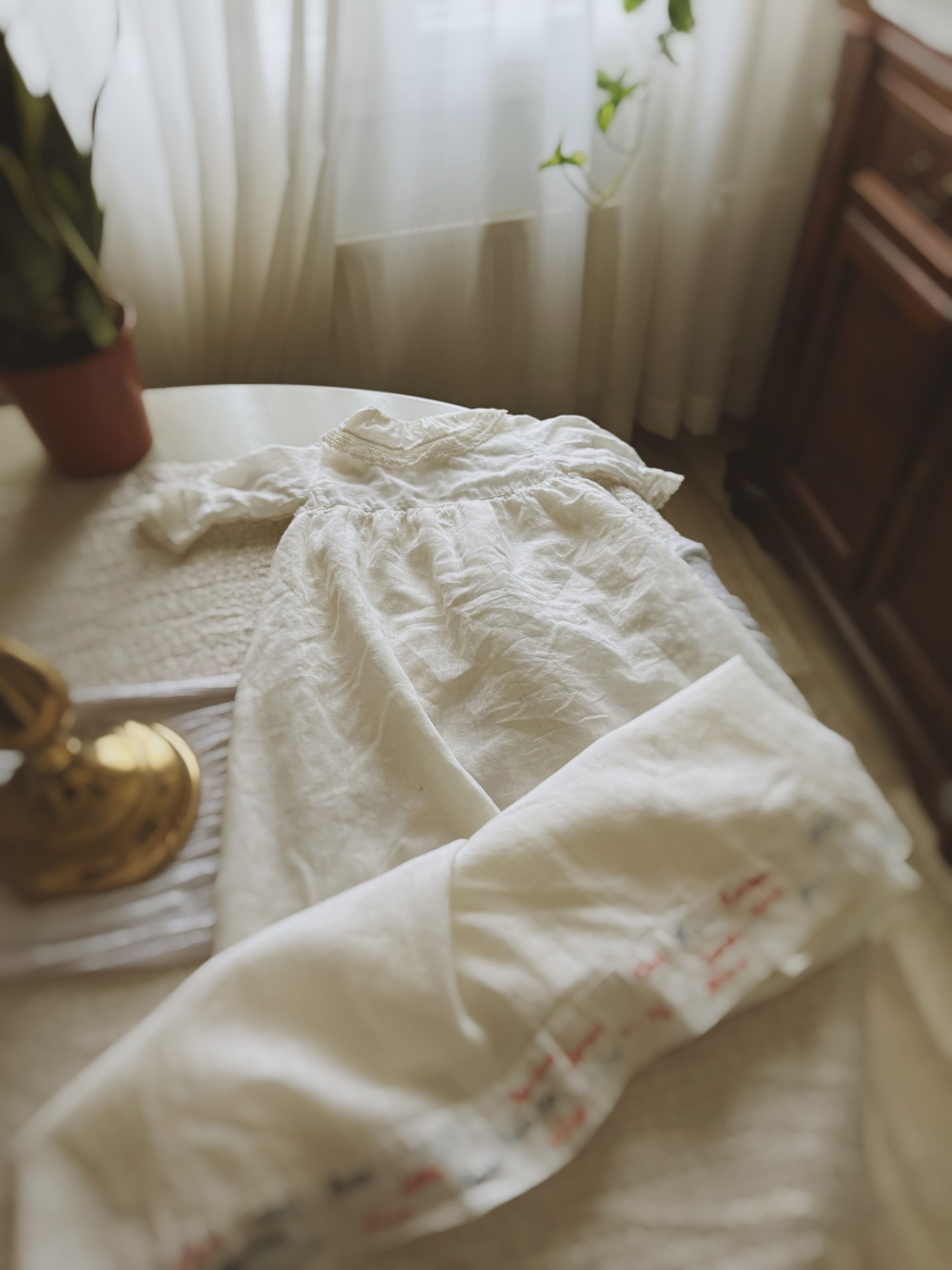
One of the most beautiful surviving symbols of our family’s sense of community is a nearly century-old handmade christening gown. The gown has been worn by dozens of babies born into our family. Each child leaves a mark on it, because the women in our family have embroidered the name of each baptized baby onto its hem. I was given the honor of embroidering the name of my oldest sister’s daughter onto the gown.
My father’s aunt taught us a traditional Karelian wartime-era food called röpöskä when we were children. In its simplest form, rye was ground into a coarse meal in a coffee grinder and mixed with freshly crushed lingonberries or lingonberry jam. As children, it was simply an unusual treat that an adult relative had taught us to make. Only later did I understand that it was also a small piece of old Eastern Finnish food heritage.
There is a similar example of cultural continuity on my mother’s side of the family. My maternal grandmother’s mother lived to be almost 98 years old and still brewed coffee in the traditional Finnish way well into the 2000s. She simply refused to give it up.
She was also a very determined woman. So determined that even my parents apparently did not dare argue when she served her coffee to me and her other great-grandchildren. It was the kind of coffee that left your legs trembling for a while afterwards. My father described her by saying, “She never skimped on the coffee grounds.”
My oldest sister, meanwhile, said that she never drank coffee anywhere else at the time except at our great-grandmother’s house. She, like the other children, was forced to drink it. The alternative was strong cocoa made with Van Houten cocoa powder, so neither option exactly worked in our favor.
I remember those moments with warmth, and I have to say that there was simply no arguing with the authority of someone who had lived through wartime. Even then, my sisters and I wondered about her — and especially about how much she had seen in her lifetime. So young Sanni simply picked up the cup and drank her coffee without complaint.
To me, memories like these reveal something essential about Finnish cultural heritage. Not every tradition survives because someone consciously decides to preserve it. Sometimes it survives simply because someone keeps holding on to it. Someone brews their coffee in the same way year after year, makes handicrafts, prepares a familiar dish or continues to use an old word, even as the world around them changes.
Later in life, I found a commemorative edition of poems by Eino Leino among my grandparents’ belongings, and I have been more than a little hooked on traditional Finnish poetry ever since. My interest in poetry has taken me so far that my home now contains, in addition to works by Leino, Kivi and Runeberg, the Kalevala, Suur-Kantelettaret and Kanteletar.
As a Savonian, the traditional poetic metre feels surprisingly natural to me. The dialects of Savonia and Karelia have much in common, and perhaps that is why the rhythm of the Kalevala and Kanteletar does not feel foreign to me, even though the world from which they emerged existed long before my own time. As I began to study the poetry and its language more closely, my interest also expanded into my own linguistic heritage.
The more I have become acquainted with Karelian, Livvi-Karelian and Veps, the more clearly I have come to see my own Savonian dialect as part of a much broader Finnic linguistic landscape.
I notice this particularly clearly in Karelian poetry and old incantations. For example, an incantation recorded in Vuokkiniemi says:
Još šie lienet tulešta tullun, niin šie tuleh mäne!
Još šie lienet veještä tullun, niin šie veteh mäne!
Još šie lienet tuulešta tullun, niin šie tuuleh mäne!
The incantation sends an illness back to where it is believed to have come from: if it came from fire, it must go back to fire; if it came from water, it must return to water; and if it came from the wind, it must return to the wind.
Northern Savonian dialects contain many of the same or very similar words and grammatical structures. For example, lie, lienet, lienee, vesj, vejestä and mäne are also familiar forms within the Savonian linguistic environment.
When I look at all of these things together, Finnishness begins to look very different to me. From the outside, Finnishness can seem quite simple, because so much of its culture is so ordinary and deeply internalized that we do not even recognize it as culture. But when you begin following in the footsteps of your own relatives, you start to see how much history, tradition, skill, language, food, community and quiet knowledge are hidden within ordinary life.
Perhaps that is where the richness of Finnish cultural heritage lies. It is not always conspicuous, nor does it need to be proclaimed. It lives in coffee brewed in an old-fashioned way, in handicrafts, traditional foods, dialect words, the rhythm of poetry, family members showing up to help with one another’s projects, and in the simple fact that someone comes when you need a hand. It lives in things that one generation does so naturally that they do not even realize they are passing them on to the next.
That is why being 98.9% Finnish by genetic ancestry no longer feels like a boring result to me. When I began following the traces of my Finnish roots, I found an entire culture beneath them.
— Sanni M.